

Sarah sat down with lead actress Nadia Melliti to talk about her role in The Little Sister (see our review) and her personal connection to Fatima, empowerment, and fashion.
NADIA MELLITI ABOUT THE HARDEST SCENE
“The hardest scene for me was early in the film, when Fatima attacks her classmate Rayan,” Nadia Melliti recalls. “I kept apologizing to Mahamadou for the level of aggression I brought into it. But he encouraged me to keep going, because it felt so real.” For Melliti, that outburst is a turning point: “What mattered most to me was showing that, in this moment, Fatima lets go of the homophobia she performs in public. Rayan is a reflection of her own homosexuality—and she can’t bear seeing it exposed.”
NADIA ABOUT HER PASSION
The idea of emancipation, Melliti says, has shaped her long before this role. Football played a crucial part in that journey. “I was always looked at strangely because it’s still seen as a ‘male’ sport. Women face prejudice, sometimes even ridicule. I had to fight just to be allowed to play.” She was nine when she first wanted to join a football club. Her mother didn’t forbid it, but she was afraid of what it would mean for her daughter to be surrounded only by boys. “It took two years. I was eleven before I was finally allowed to play.”
Once she did, the resistance continued. “People told me: if you play football, you’re a boy. It’s a men’s sport, you won’t make it anyway. The girls in my class said they didn’t want to play with me because I was ‘like a boy.’” She laughs softly. “Honestly, I didn’t mind. I didn’t want to skip rope either.”
What stayed with her, however, was how powerful sport can be as a tool for integration. “You meet people, you build friendships. It’s a team sport—you train together, struggle together. The team becomes like a family.” That experience fed directly into The Little Sister. Football doesn’t exist in the original script, but Melliti’s passion helped shape the character. “There were so many points where I recognized myself in Fatima—her personality, her determination, her fighting spirit.”
NADIA ABOUT EMPOWERMENT
In French, Melliti explains, empowerment is closely tied to the idea of autonomy. “Autonomy means developing a critical mind and becoming an independent person. That’s essential. It’s deeply connected to emancipation.” For her, empowerment means learning to question—society, norms, and oneself. “It’s about being able to act within society, with rights and responsibilities, but also with your own perspective.”
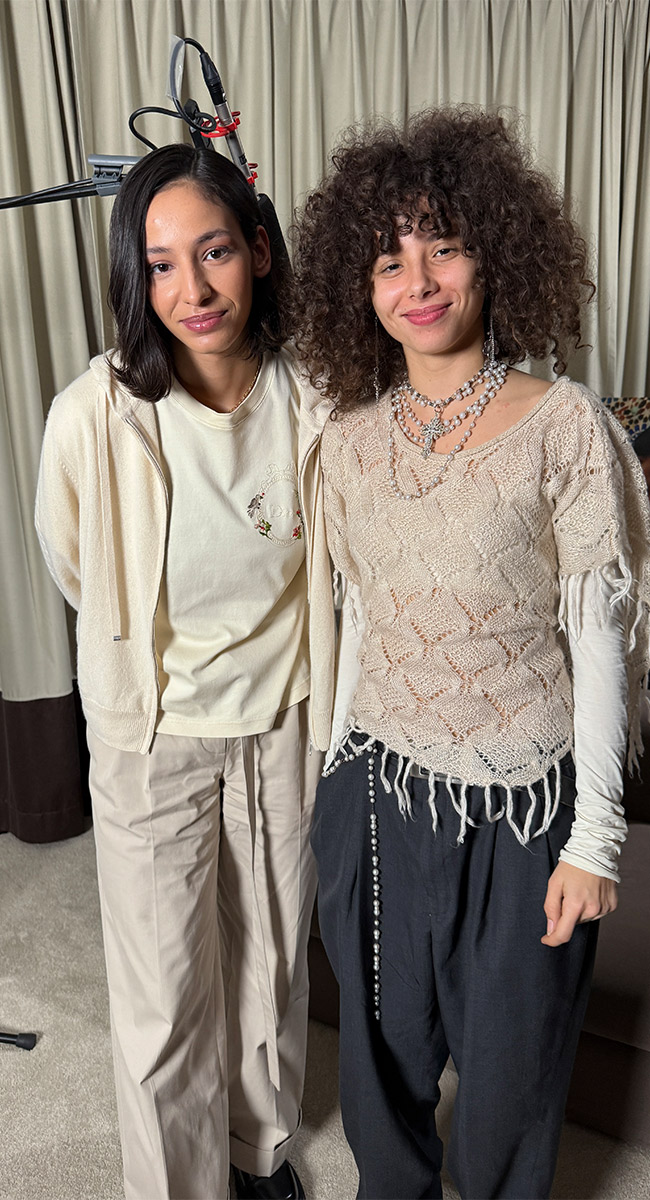
This process is mirrored in Fatima’s transition from school to university. “Suddenly there’s no one telling her what to do, what to learn, how to organize her life. She has to take responsibility herself.” Melliti relates to that deeply. “I went through that transition not long ago. I’m still studying, I come from a similar background—it felt very close.”
ABOUT CLOTHES & PREJUDICES
Her relationship to clothing is another point of connection. “Sometimes I dress in a way society labels as masculine, sometimes very feminine. I don’t want to be put into a box. I love mixing things.” What frustrates her are rigid gender codes. “If you wear this, you’re a boy. If you wear that, you’re a girl. That’s not healthy. We shouldn’t judge people by their clothes, but by their actions. Clothing has nothing to do with gender—it’s a form of expression, just like art.”
Melliti also speaks openly about prejudice tied to origin. She recalls receiving a message on social media asking how she, “as someone from Algeria,” could take part in a film like this—and whether she wasn’t ashamed. “I replied that origin and mindset are not the same thing. Individuality matters. Just because I come from Algeria doesn’t mean I have to think or live in a certain way.” Such assumptions, she says, are deeply limiting. “They prevent us from truly getting to know each other. For me, life is about meeting people, understanding them, and finding ways for all of us to live well together.”
Text & Picture: Marco Kokkot Interview: Sarah Ben Hamza






1 Comment